
Mehr Energieeffizienz durch moderne Ventilatorarrays
Modular fan walls consist of several small, direct-drive EC fans. These systems have been shown to consume significantly less energy than older, large fans. In various retrofit projects, energy savings of between 30 and 60 per cent have been achieved, as modern fans have a broader efficiency curve and can be precisely adjusted to actual demand through variable speed control.
In addition, flow conditions within the system can be optimised because arrays deliver air more evenly and with lower pressure loss.
- Greater operational reliability and redundancy
A single large, ageing fan always poses a risk of failure. A fan array, on the other hand, usually consists of several units, which can continue to operate even if one fan fails. This ensures that ventilation remains operational even in critical areas until a replacement is available or repairs have been carried out. This redundancy is highlighted as a key advantage in numerous retrofit examples. - Better airflow with the same footprint
- Spürbar leiserer Betrieb
Alte Ventilatoren verursachen durch Riemenantriebe, Unwuchten oder Verschleiß and diversen Lagern oft höhere Geräuschkulissen. Ventilatorwände mit modernen Kleinantrieben verteilen die Luftleistung hingegen auf mehrere leise laufende Module. Retrofit‑Fallstudien berichten von deutlich reduzierten Schalldruckpegeln und einem ruhiger arbeitenden Gesamtsystem.
How a typical fan wall retrofit works
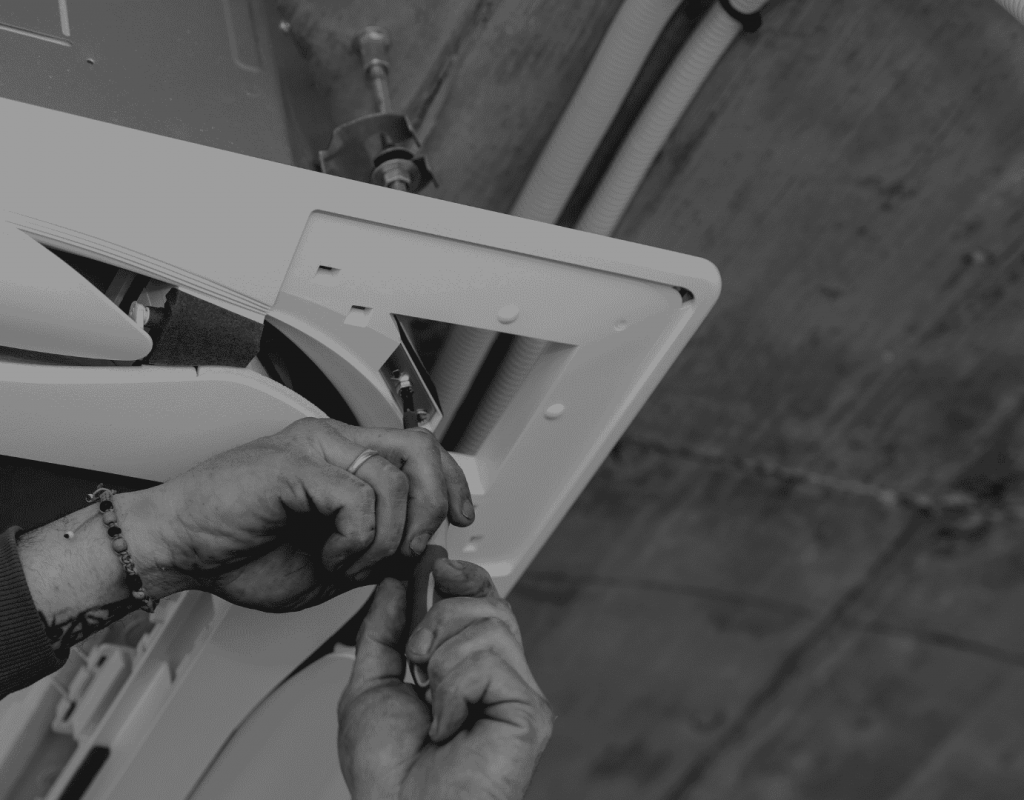
A retrofit begins with the removal of the old fan. A new partition or support structure is then installed within the existing unit, serving as a ‘back panel’ for the fan assembly. Specialist sources demonstrate how modular panels and mounting systems are used to create a suitable housing structure. The fans are then installed individually, wired up and connected via a central control system – often using prefabricated plug-in systems, which further speeds up installation.
Once the system is up and running, the speeds and operating strategies are optimised so that the fan bank delivers exactly the required airflow.
When a fan wall retrofit is particularly worthwhile
A retrofit is particularly worthwhile if:
- high energy costs are caused by outdated fans,
- Ventilation systems can become noisy or cause vibrations,
- the aim is to minimise the risk of failure,
- existing enclosures are to be retained,
- as structural additions are limited,
- solutions that are easy to refurbish and involve minimal downtime are required.
Retrofit examples from office buildings, airports and industrial facilities demonstrate that the benefits are universal: lower costs, reduced CO₂ emissions, more stable operation and a modern, efficient air transport system.
Conclusion: Fan walls are the upgrade that restores the performance of existing systems
A fan wall retrofit combines technical efficiency with practical feasibility: lower energy consumption, greater redundancy, improved controllability and reduced noise levels – all achieved in surprisingly short installation times. For operators, this is one of the most economically attractive modernisation measures – without the need for costly, comprehensive structural refurbishments.
Experience from numerous retrofit projects shows that replacing old fans with modern modular systems can have a significant impact on efficiency, operational reliability and the service life of the system. Many buildings today face the same challenges: rising energy consumption, ageing plant rooms and, at the same time, the need to avoid operational downtime. This is why there is growing interest in solutions that allow existing systems to continue to be used whilst bringing them up to the latest energy standards.
Anyone interested in comprehensive ventilation and air-conditioning systems – that is, the full range of modern building services engineering, from air-handling units to integrated system solutions – will find that our parent company, FläktGroup, is one of the leading providers in the field of energy-efficient indoor air technology. For decades, FläktGroup has been developing technologies for comfortable, safe and sustainable indoor air. Its products, services and innovations cover a particularly broad range of applications that can be seamlessly combined with modern retrofit approaches.
This means that our technical focus on regulation, modernisation and control systems complements the FläktGroup’s expertise in ventilation systems perfectly – enabling us to deliver holistic solutions throughout the entire lifecycle of a system.